Yozan Kiln: Reviving the Stories Behind Japanese Ceramics

I've used the same small Yozan mamezara (bean plates) for years without thinking much about their patterns, beyond their beauty. A checkerboard was just a checkerboard. The blue vines were just pretty. A morning glory was just a beautiful floral motif.
But at Yozan Kiln, every shape and pattern has a story. During my visit, I sat down with the kiln's president, Tsuji Kenji (辻賢嗣), who has spent around 50 years working with ceramics. As we talked, he moved from one piece to another, revealing the history behind their shapes, patterns, and even their names.
By the end of the afternoon, I realized he wasn't just protecting old designs. He was learning about where they came from, then figuring out how they could still earn a place on a modern table.
The Story of Yozan Kiln and Hizen Yoshida-yaki Ceramics

Yozan Kiln, formerly Tsujiyo Seitosho, sits in Yoshida, a district of Ureshino in Saga Prefecture. The porcelain made here is called Hizen Yoshida-yaki ceramics (肥前吉田焼), and the area has been firing it for more than 400 years. The family's own roots, though, trace back to nearby Arita.
He told me the family's main house is Tsuji Seijisha (辻精磁社) in Arita, an official kiln appointed to produce porcelain for the imperial family. Toward the end of the Edo period, during the Ansei era (1854 to 1860), the family's second son Yosuke left Arita and opened his own kiln here in Yoshida.
In Japan, it’s common for the eldest son to take over family businesses, while a second son either stays on or leaves to establish himself elsewhere. Tsuji is the sixth generation in that line and found himself responsible for it much sooner than expected, at 23.
Japanese Ceramic Revival: Beyond Reproduction

The longer we talked, the harder it was to ignore the books. They are stacked everywhere around Tsuji’s office. Throughout our talk, he kept referring back to them, pulling from old sources, Edo-period ceramics especially, to study the forms and patterns Yozan still makes.
“Above all, I just like them, the old things,” he told me.

He has also traveled with his design staff to China, Turkey, Spain, and Germany. China was about tracing the roots of Japanese ceramics back to their source, while Europe was about design itself, including the Bauhaus in Germany. All of it feeds Tsuji’s work, but when he described Yozan's relationship with historical ceramics, he drew a line I keep thinking about.
"Not so much reproduction as revival."
For him, they're a starting point, not a template. He combines them with decades of study to arrive at something that belongs to Yozan. And after half a century, he is unapologetic about following his own taste.
"After 50 years of this, I pretty much know my own taste. It's not about whether it sells. I end up making the things I like," he said.
Traditional Edo-Period Patterns & Ceramic Stories

Perhaps the best way to understand what the president means by “revival” is through the stories behind Yozan's designs.
During our conversation, he picked up a small vessel called a nozoki, a deep dish dating back to the Edo period. “Unless you peer in, you can't see the food,” he explained. Traditionally used for small servings such as shiokara, Yozan has recently brought the form back into production.
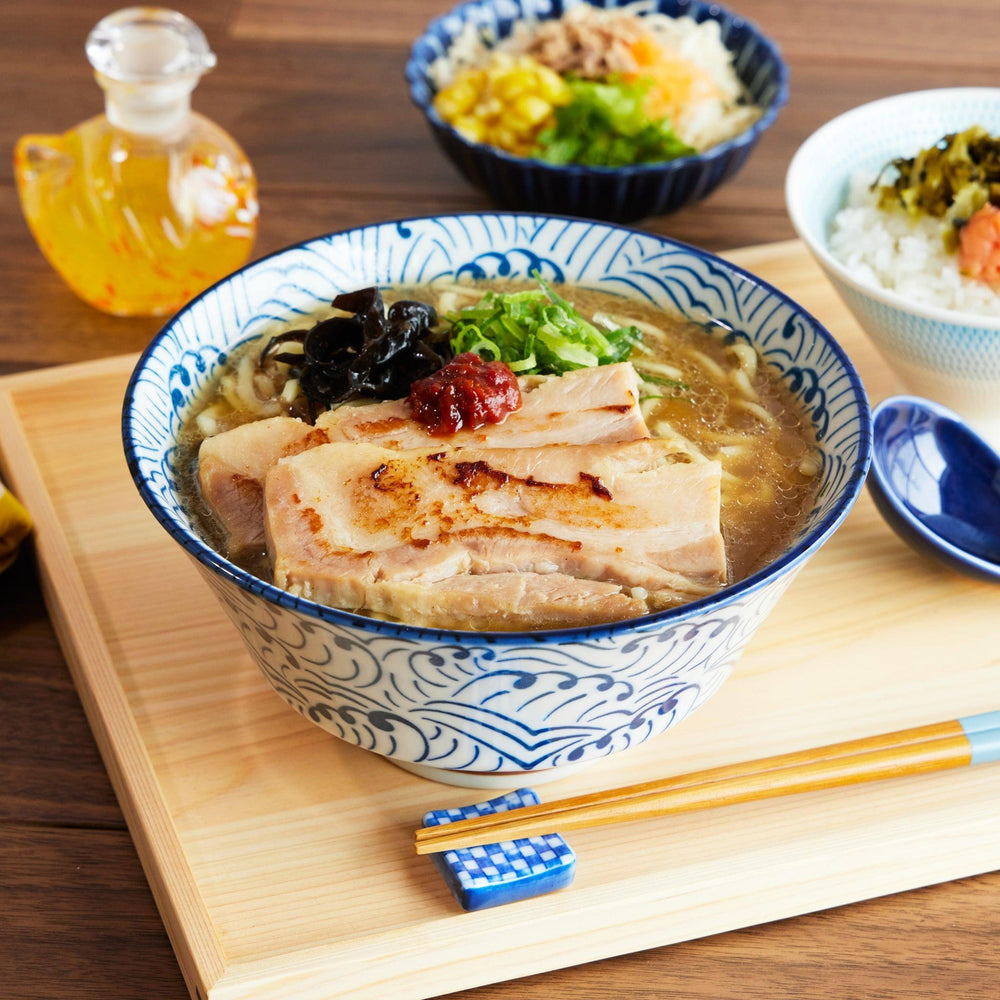
Other stories are hidden in the patterns. Many are painted in sometsuke (染付), the classic blue-and-white underglaze style that Arita made famous, and each carries more history than its simple lines suggest. The familiar ichimatsu checkerboard evolved from an earlier ishidatami, or flagstone, pattern before becoming associated with kabuki actor Sanogawa Ichimatsu during the Edo period. A deer-and-maple-leaf design prompted the president to recite a classical poem from memory, revealing cultural references once understood through seemingly simple motifs.
I love the design process here, and how it’s not just about copying, but about understanding their story and character. He told me that even reviving an old design still leaves room for expression. When instructing the painters on an Edo-period (朝顔), or morning glory, he tells them to paint it as if "the morning glory is dancing."
Bringing Old Designs into Today's Kitchen

Understanding these stories changed how I saw the ceramics, but I don't think their history is the only reason they still matter.
To me, they're still objects made to be used. The smaller pieces have practical places in a Japanese meal:
- Mamezara for a small side dish
- Yakumi-zara (薬味皿) for grated ginger or sliced green onion
- Kobachi (小鉢) filled with tsukemono.
I used to hesitate to use older pieces, but I've come to think they don't need to sit behind glass as precious objects from the past. We do not need to recreate an Edo-period meal to use them “correctly.” A nozoki works just as well holding tsukemono next to a bowl of rice tonight.
For us at JOC Goods, learning these stories gives another dimension to pieces we already use and share. We carry around 100 Yozan pieces, and our relationship with the kiln goes back to our very beginning. When I first opened JOC Goods, I had a set of four small Yozan mamezara made as a gift for the people around us. Those same plates became part of the collection we still carry today.
The more I learn about where these pieces come from, the more I think that using them is part of how they continue. A pattern doesn't survive just because it's written down in a book, and a bowl doesn't stay relevant because it sits on my shelf as art. They survive because someone keeps choosing to make them, put food on them, and bring them back to the table.
Sharing Tradition with the Next Generation

I visited several kilns across Kyushu on this trip, and the same question came up at nearly every one: who carries this forward? These are small towns, and young people often head to Fukuoka, Osaka, or Tokyo for work. But at every kiln I stepped into, someone was still at the wheel, still mixing glaze, still firing.
When I asked Tsuji about it, he didn’t sugarcoat anything. "At this rate, this industry goes extinct," he said, and he was quick to add that the same pressure exists in production regions all over Japan.
So I asked whether he wanted the next generation to inherit his values. He corrected me gently. "No, I'd rather share it." He described this through a-un no kokyu (阿吽の呼吸), a non-verbal synchronization and understanding that develops through years of working together. “It happens that way. It's accumulation.”
Maybe tradition works the same way for him. He studies old forms and revives them, and somewhere along the way they end up meaning something new to whoever eats off them next.
I think Yozan's ceramics carry the past with them, without staying stuck there.
Why It Matters at Your Table
Now when I set out Yozan’s plates, I see more than a pretty pattern.
I see the 23-year-old he once was, dedicating his life to learning and reviving the beauty of Japan’s historic ceramics.
That's the kind of story I want on my table, and it's why I wanted to bringthese pieces to you.
You can shop our Yozan Kiln Japanese Ceramics Collection in our online store.
What's the difference between a mamezara, yakumi-zara, and kobachi?
All three are small Japanese serving pieces with different jobs. A mamezara, or bean plate, holds a small side dish or a condiment. A yakumi-zara (薬味皿) is for aromatics like grated ginger or sliced green onion. A kobachi (小鉢) is a small bowl, deeper than either, for pickles or a simmered side.
What is sometsuke?
Sometsuke (染付) is the blue-and-white underglaze style that Arita made famous. The design is painted in cobalt directly onto the unglazed body, then covered with clear glaze and fired, so the pattern sits under the glazed surface rather than on top of it. Most of Yozan's patterns are painted this way.

Namiko Hirasawa Chen
Namiko Hirasawa Chen is the founder of JOC Goods and Just One Cookbook, where she shares Japanese home cooking and the kitchenware and tableware that go with it.